Client Document Collection Statistics (2026)
Verified 2026 statistics on collecting client documents in accounting, tax, law and mortgage lending, with sources, sample sizes, methods and a free CSV.
On this page
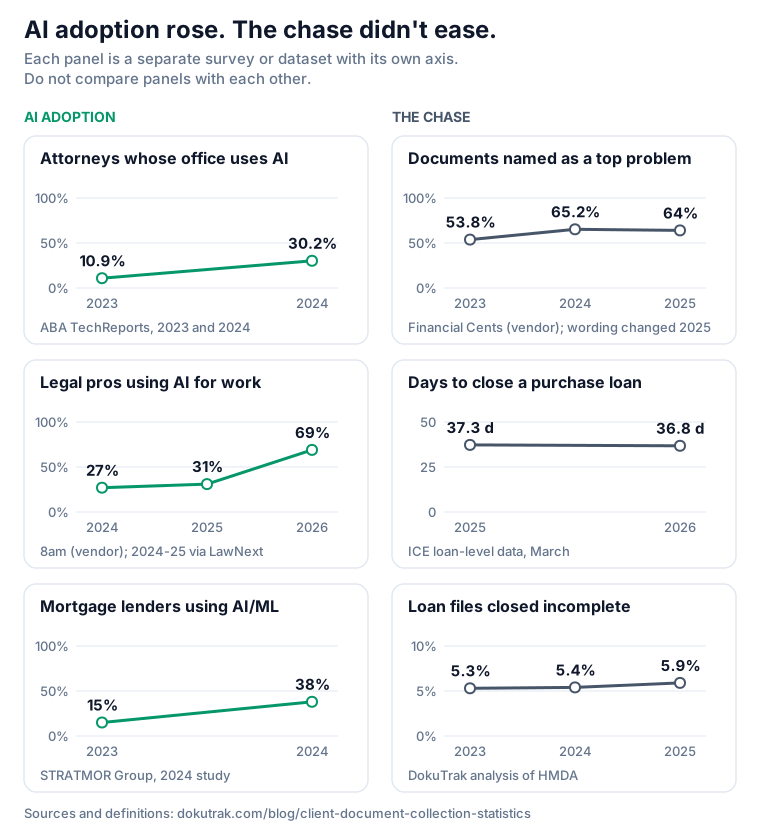
No published study shows AI shortened the document chase. Every AI adoption survey cited here rose sharply (attorneys whose office uses AI tools: 10.9% in 2023, 30.2% in 2024, ABA), while the share of surveyed accounting firms naming client documents among their biggest workflow challenges stayed at 64–65% in 2024–2025, and US purchase loans still take about 37 days to close (ICE).
Last verified: 2026-09-25 · 59 statistics · 3 original analyses of public data · Download the CSV
I build DokuTrak, a tool that asks clients for documents and follows up for you (pricing). This page is about the data, not the product. I opened every source below, matched the number to the wording, labeled the ones I could only confirm through a secondary report, and labeled who paid for each survey.
Key findings
- 65.2% of 367 surveyed accounting firms named getting documents from clients among their biggest workflow challenges in 2024; in 2025, 64% named chasing clients for information, the most common answer (Financial Cents, vendor surveys).
- 695,006 US mortgage applications, 5.9% of those with a final decision, were closed for incompleteness by HMDA-reporting lenders in 2025 (DokuTrak analysis of public CFPB HMDA data).
- US purchase loans closed in 36.8 days in March 2026, versus 37.3 a year earlier (ICE Mortgage Monitor, loan-level data, 2026).
- Workers report generative AI time savings equal to 1.6% of all US work hours (Federal Reserve Bank of St. Louis, 2025).
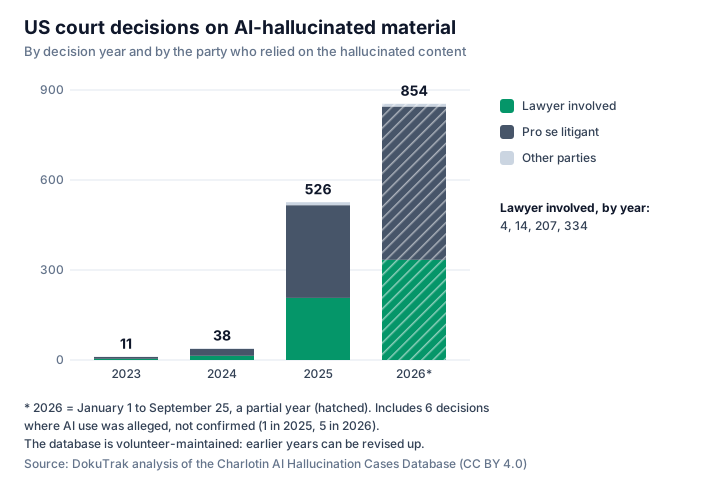
- The Charlotin database lists 854 US court decisions on AI-hallucinated material in 2026 through September 25, already more than the 526 it lists for all of 2025 (DokuTrak analysis).
- 35% of tax and audit professionals use AI tools their firm hasn't authorized (Thomson Reuters Institute, vendor research arm, global sample, 2026).
Has AI changed how professionals collect client documents?
AI changed the tools, not the chase. Adoption surged between 2023 and 2026, the indicators of document chasing did not ease, and AI added new risks at the intake desk. No source measures AI's effect on document-chasing time directly, so this section puts the series side by side and lets each keep its own definition.
AI adoption rose while document-chase indicators did not ease. Sources: ABA, 8am (2024–25 via LawNext), STRATMOR Group, Financial Cents, ICE loan-level data, DokuTrak analysis of public CFPB HMDA data.
Download the AI adoption vs. document chase chart (SVG)
Adoption surged. Attorneys whose office uses AI tools went from 10.9% in 2023 to 30.2% in 2024 (ABA TechReports, 440 and 512 respondents).12 A different survey, measuring personal use of general-purpose GenAI, found 69% of legal professionals using it for work in 2026, up from 27% and 31% in its two previous editions (8am, a vendor, 1,300+ US legal professionals; the 2024 and 2025 points as reported by LawNext).34 Professionals whose organization uses GenAI went from 22% to 40%, and 34% at tax firms (Thomson Reuters Institute, the research arm of a software vendor; global sample of 1,514 respondents in 27 countries).5 Mortgage lenders using AI or machine learning went from 15% in 2023 to 38% in 2024 (STRATMOR Group, 2024 Technology Insight Study).6
The chase did not ease. Getting documents from clients was named by 53.8%, then 65.2%, then 64% of surveyed firms, and it was the most-cited workflow problem in 2024 and 2025 (Financial Cents, vendor surveys; the question wording changed in 2025).78 Purchase mortgages close in 36.8 days versus 37.3 a year earlier (ICE loan-level data).9 Mortgage applications closed for incompleteness went from 5.3% to 5.4% to 5.9% of decided applications between 2023 and 2025 (DokuTrak analysis of public CFPB HMDA data). Workers report GenAI time savings equal to 1.6% of all work hours (St. Louis Fed).10 Tax pros still name missing or incomplete client information as the season's biggest problem (NATP, 2026).11
AI added new risks. AI-generated document fraud grew nearly 5x from May to December 2025, from a small base (Inscribe, vendor).12 35% of tax and audit professionals and 34% of law-firm professionals use AI tools their firm has not authorized (Thomson Reuters Institute, vendor research arm, 2026).1314 The Charlotin database lists 38 US court decisions on AI-hallucinated material in 2024, 526 in 2025 and 854 in 2026 through September 25 (DokuTrak analysis).
Three honesty notes before the details. First, the adoption surveys ask different questions: office use versus personal use, "any AI" versus GenAI. Read each number with its definition. Second, nothing here shows AI caused or failed to cause any of these numbers. Third, the fair summary is narrow: no published data shows the chase got shorter, and these indicators did not get better.
Accounting and tax: how hard is it to get documents from clients?
It is the most-cited workflow problem in the only survey series that asks: 64–65% of surveyed firms name it among their biggest challenges. A typical engagement takes days of back-and-forth, and 49% of surveyed professionals say their firm lets clients email sensitive forms.
What share of accounting firms say chasing client documents is a top problem?
65.2% of 367 surveyed firms named "getting info and documents from clients" among their biggest workflow challenges in Financial Cents' 2024 report, the top answer, up from 53.8% of the previous year's respondents.7 The 2025 edition, a survey of 816 firm owners, found "chasing clients for information" was the most common bottleneck at 64%, in a question where respondents could pick several challenges, and said getting documents from clients "is still the biggest workflow issue."8
The 2024 sample was 367 owners and admins of accounting, bookkeeping and tax firms, mostly in North America, drawn from the vendor's email list between November 2023 and January 2024. Financial Cents sells workflow software to these firms. In 2022, a Wolters Kluwer survey of 1,445 US tax and accounting firms found that "half of this year's survey respondents reported late or unprepared clients to be a top challenge."15 Different vendor, different wording, same problem near the top.
How long does it take to gather a client's information for one engagement?
49% of accounting professionals spend 1–2 days communicating with clients to gather everything for a typical engagement, 36% spend 3–7 days, and 16% spend two weeks or more (Canopy, a vendor of accounting software, with CPA Practice Advisor, 2024).16 The survey covered 240 accounting professionals in June 2024. The same respondents spend 9.3 hours a week on client communication and want to bring it down to 7.2.
Financial Cents asked firms to recall how fast clients sent documents before they automated. 49.9% said clients took several days, 18.5% said weeks or months, and 1.9% said same or next day.8 Read this with care: it is a vendor survey, and a self-reported before-and-after from users or prospects of workflow software, so it leans toward firms that already adopted it.
Do accounting firms still accept tax documents by email?
Yes, about half do. 49% of respondents said their firm allows clients to email sensitive information such as tax forms, and 51% said it does not (Canopy with CPA Practice Advisor, 2024, 240 respondents, vendor).16 What the rules say about that is in the security section below. If you are building a list for clients, my tax document checklist covers what to ask for.
Do missing documents push tax returns past the deadline?
Tax pros say so, but no one counts it. The National Association of Tax Professionals reported in April 2026 that "the biggest issue wasn't complex tax situations – it was missing or incomplete information," which resulted in returns "being filed closer to the deadline or being placed on extension."11 That comes from early responses from NATP members, with no sample size and no percentage. The IRS estimates that "more than 20 million taxpayers" were expected to file by the October 15, 2025 extended deadline.17
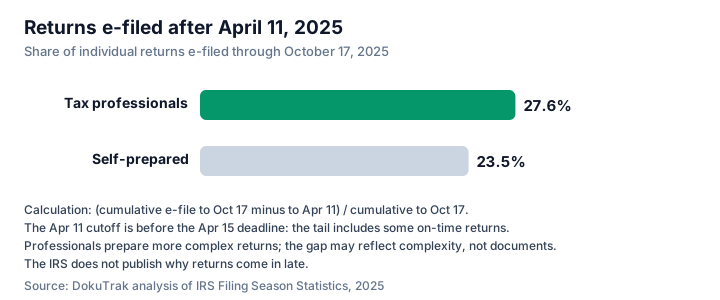
To see whether professionals carry a longer tail than self-filers, I compared the IRS weekly filing tables. More than a quarter (27.6%) of the returns tax professionals e-filed through October 17, 2025 arrived after April 11, compared with 23.5% of self-prepared returns (DokuTrak analysis of IRS filing season statistics).
Share of 2025 e-filed individual returns received after April 11. Source: DokuTrak analysis of IRS Filing Season Statistics.
Download the IRS late e-filing chart (SVG)
How I calculated this. Source: IRS Filing Season Statistics, weekly newsroom tables for the weeks ending April 11, 202518 and October 17, 2025.19 Inputs: returns e-filed by tax professionals, cumulative, 62,803,000 to April 11 and 86,758,000 to October 17. Self-prepared e-file: 51,104,000 and 66,839,000. Calculation: (86,758,000 − 62,803,000) / 86,758,000 = 27.6%; (66,839,000 − 51,104,000) / 66,839,000 = 23.5%. Pulled 2026-09-25. Limitations: (1) the April 11 cutoff falls before the April 15 deadline, so the "after April 11" tail includes a few days of on-time filings; (2) the IRS does not publish why returns come in late: the gap is consistent with the extension tail NATP describes, but it does not prove documents caused it; (3) professionals prepare more complex returns (business income, extensions filed by default), so the gap may reflect complexity rather than missing documents. Cite as "DokuTrak analysis of IRS filing season statistics (2025)."
How many tax preparers are there in the US?
886,338 people hold a current preparer tax identification number (PTIN) for 2026, according to the IRS Return Preparer Office, with data as of September 1, 2026.20 Among them are 209,076 certified public accountants and 71,966 enrolled agents. It is an administrative count, and some preparers hold several credentials.
How much time does a client spend preparing their own tax paperwork?
The IRS estimates a Form 1040 takes 12 hours and costs $290 on average, and recordkeeping is the largest part of that time.21 Taxpayers with business income average about 21 hours and $610. These are national averages from the IRS's Paperwork Reduction Act model in the 2025 instructions. That recordkeeping is what the professional waits for.
Law firms: how do clients send documents, and how fast do firms answer?
Mostly by email, and firms answer more slowly than clients expect. Fewer than half of lawyers work at firms that offer secure online document sharing, and the gap between solos and big firms is wide.
How many law firms let clients share documents securely online?
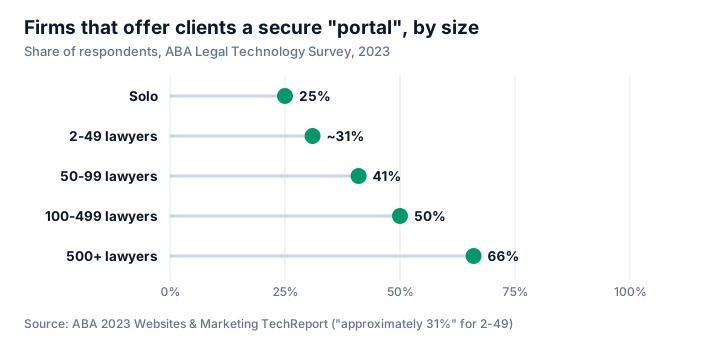
35% of lawyers said their firm offers clients "a secure client portal," only 12% regularly use one to communicate with clients, and 53% said their firm does not offer one (ABA 2023 Websites & Marketing TechReport).22 The data comes from the ABA Legal Technology Survey of private-practice lawyers. The ABA has not republished these questions after 2023.
Size is the main divide. 25% of solos offer one, compared with 66% of firms with 500 or more lawyers. Small firms are where the gap sits; I cover the tools they use in AI tools for small law firms.
Law firms offering clients secure online access, by firm size. Source: ABA 2023 Websites and Marketing TechReport.
Download the law firm secure sharing chart (SVG)
Online document sharing more broadly follows the same curve. In 2023, 48% of respondents said their firm offered document sharing and 45% said it did not, with solos lowest at 36%.22 In 2022, the figure was 40%.23
How do lawyers communicate with clients?
Email first. 92% of lawyers use email with clients, 86% the telephone and 18% text messaging (ABA, 2023).22 Face to face follows at 45%, videoconferencing at 37%, and postal mail at 19%.
What do legal clients expect?
In 2020, 69% of consumers said they prefer working with a lawyer who can share documents electronically "through a web page, app, or online portal" (Clio Legal Trends Report, vendor, 2020).24 In 2019, 79% of legal consumers said they expected a response within 24 hours (Clio, 2,000 US consumers).25 Both are vendor surveys, and both are several years old: read them as what clients said they expected in those years. They measure different people in different years, so I don't compute a gap between them and the ABA figures above.
Do law firms answer as fast as clients expect?
No. In a 2024 secret shop of 500 law firms, only 33% responded to an email inquiry, down from 40% in 2019, and 48% were essentially unreachable by phone (Clio, vendor, 2024).26 The shops ran from June 20 to July 5, 2024. Slow replies plausibly slow the documents too, though no study measures it.
Mortgage and lending: how often do files stall on documents?
Often enough to measure. HMDA-reporting lenders close hundreds of thousands of US applications a year because the file was never completed, 16% of borrowers redid paperwork, and a purchase loan still takes over a month to close.
How many mortgage applications are closed because the file is incomplete?
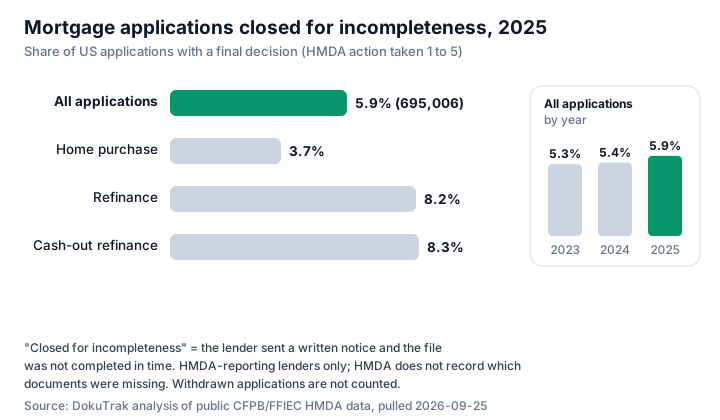
In 2025, HMDA-reporting lenders closed 695,006 US mortgage applications because the file was incomplete, 5.9% of all applications that reached a decision (DokuTrak analysis of public CFPB HMDA data). For refinances, it was about 1 in 12. By purpose, the rate was 8.2% for refinances, 8.3% for cash-out refinances and 3.7% for home purchases. The overall rate went from 5.3% in 2023 to 5.4% in 2024 to 5.9% in 2025.
US mortgage applications closed for incompleteness in 2025, by loan purpose, with the 2023–2025 trend. Source: DokuTrak analysis of public CFPB HMDA data (HMDA-reporting lenders).
Download the HMDA chart (SVG)
How I calculated this. Source: CFPB/FFIEC HMDA Data Browser API,
nationwide aggregations for 2023, 2024 and 2025, filtered by loan purpose for
the breakdown (home purchase, refinance, cash-out refinance).27 Filter:
action_taken = 5, "File closed for incompleteness." Denominator:
applications with a final action 1 to 5 (originated, approved not accepted,
denied, withdrawn, closed for incompleteness); purchased loans and
preapproval-only records are excluded; all lien and property types. 2025:
695,006 / 11,766,671 = 5.9%. Home purchase 199,434 / 5,374,348 = 3.7%;
refinance 150,657 / 1,845,672 = 8.2%; cash-out refinance 163,248 / 1,969,413 =
8.3%. 2024: 581,940 / 10,781,992 = 5.4%; 2023: 536,137 / 10,062,636 = 5.3%.
Pulled 2026-09-25. Limitations: "Closed for incompleteness" means the
lender sent a written notice of incompleteness and the applicant did not
complete the file in time. It is the regulatory category closest to "missing
documents," but HMDA does not say which items were missing. Withdrawn
applications (14.5%) are not counted: they have many causes. Only institutions
subject to HMDA report, small lenders are exempt, and one borrower can file
several applications. Cite as "DokuTrak analysis of public CFPB HMDA data
(2025)."
How many borrowers had to redo paperwork or delay closing?
16% of borrowers redid or refiled paperwork because of processing delays, and 21% had a closing delay, according to a February 2025 Federal Reserve Bank of Philadelphia report.28 It links the National Survey of Mortgage Originations to administrative data for 38,648 borrowers with loans from 2013 to 2021. The same report found that delays at origination cut the likelihood of refinancing in response to rates "by more than half (by 5.7 percentage points)." A slow file costs the borrower later, not only at closing. My mortgage document checklist lists what lenders usually ask for.
How do borrowers send documents today?
69% of borrowers "used an online portal for uploading documents electronically" (ICE Mortgage Technology, 2025 Borrower Insights Survey).29 The survey covered 2,002 US adults, including 1,000 homeowners with a mortgage taken in the last 10 years. ICE sells mortgage technology to lenders, so this is a vendor survey.
How long does a mortgage take to close in 2026?
The average purchase loan closed in 36.8 days in March 2026, down from 37.3 days a year earlier, the fastest since ICE began tracking the metric in 2019 (ICE Mortgage Monitor, May 2026, from ICE loan-level origination data).9 The typical purchase loan moved from application to rate lock in 11 days, then from lock to closing in another 26. ICE does not attribute the change to AI, and neither do I.
Do slow onboardings cost financial firms clients?
Yes, by their own account. In a 2025 vendor survey of 600 senior decision-makers at financial firms in the UK, US and Singapore, 70% said they lost clients in the past year due to inefficient onboarding, and abandonment rates average around 10% (Fenergo).30
Is it safe to collect client documents by email?
For many firms, plain email does not meet the rules. US regulation requires covered firms to encrypt customer information in transit, the IRS tells tax pros not to send client files by unencrypted email, and the IRS warns that fake "document request" emails are used to target tax professionals. This is a summary of public sources, not legal advice.
What do the FTC and IRS require?
The FTC Safeguards Rule treats tax preparers as financial institutions: "An accountant or other tax preparation service that is in the business of completing income tax returns is a financial institution," and the rule's scope list includes mortgage brokers and tax preparation firms.31 It requires firms to "protect by encryption all customer information held or transmitted by you both in transit over external networks and at rest" (16 CFR 314.4(c)(3)).31 The rule's exception: if encryption is infeasible, a firm may use effective alternative compensating controls reviewed and approved by its Qualified Individual.
IRS Publication 4557 is blunter: "Send only password-protected and encrypted documents if you must share files with clients via email or use Secure File Transfer Protocol (SFTP) to transmit files instead of email."32 My guide on how to send and receive documents securely turns that into steps.
How often are accounting and law firms breached?
Professional-services firms had 478 publicly reported data compromises in 2025, up 39% from 344 in 2024 and up 162% from 182 in 2021 (Identity Theft Resource Center, 2025 Annual Data Breach Report).33 The ITRC notes these firms are "increasingly used as 'stepping stones' to access multiple corporate clients."
Through spring 2024, the IRS had received reports of nearly 200 tax professional data incidents potentially affecting up to 180,000 clients (IR-2024-180, the latest published figure).34 Among lawyers, 29% said their firm had experienced a security breach, 19% did not know, and 52% said it had not (ABA 2023 Cybersecurity TechReport).35 The ABA's definition of breach includes lost devices and break-ins.
How do attackers use document requests?
They impersonate them. The IRS's 2026 Dirty Dozen warns that tax professionals "remain targets of 'new client' or 'document request' emails that deliver malicious links or attachments," and that scammers use hacked client inboxes to find "a genuine email from a previous victim's email account sent to their tax professional."36 Business email compromise produced $3,046,598,558 in reported losses from 24,768 complaints in 2025 (FBI IC3).37 IC3 counts only complaints, so the real total is higher.
How often do documents go to the wrong person?
49% of cybersecurity leaders said they experienced incidents caused by misdirected email (KnowBe4, State of Human Risk 2025).38 That survey covered 700 security leaders and 3,500 employees in 14 countries, and KnowBe4 sells misdirected-email protection. On the receiving side, 42% of lawyers said email encryption was available to them, falling to 33.1% for solos (ABA, 2023).35 More on this in why email fails for document collection.
Do reminders actually get people to act?
Yes, modestly. The evidence comes from courts, vaccines and taxes, because no study measures reminders for document requests. Treat everything in this section as an analogy, not a measurement of the chase.
How much do reminders change behavior?
Text reminders cut missed court dates by 21% in New York City: "receiving any text message reduced failures to appear by 8 percentage points, which represents a 21% relative reduction" (Fishbane, Ouss and Shah, Science, 2020).39 The authors found that many people who miss court are "not intentionally skipping court but are effectively unaware of court." That sounds a lot like a client who forgot the request was in their inbox.
In a 689,693-patient randomized trial, reminder texts raised pharmacy flu vaccination by 2.0 percentage points, or 6.8%, and the most effective messages "delivered reminders on multiple days" (Milkman et al., PNAS, 2022).40 In UK field experiments with more than 200,000 people, those who received a reminder letter were "nearly four times more likely to pay their tax bill" than those who did not (Hallsworth et al., NBER, 2014).41
How big is the effect at scale?
Smaller than the papers suggest. Across 126 randomized trials run by two US government nudge units on more than 23 million people, nudges raised take-up by 1.4 percentage points, an 8.0% increase, versus 33.4% in published academic studies (DellaVigna and Linos, Econometrica, 2022).42 Expect a modest lift from reminders, not a miracle. The practical side is in how to stop chasing clients for documents and my document request email templates.
How is AI changing document collection, and what new risks does it bring?
AI is spreading fast, mostly in the work around documents rather than in getting them. Meanwhile clients are using it too, fake documents are getting easier to make, and about a third of tax and legal professionals use AI tools their firm hasn't approved.
How fast did professionals adopt AI?
Fast, in every survey cited here; the four series and their definitions are in the first section. One detail they add: solos lag. 17.7% of solo attorneys said their office used AI-based tools in 2024, against 47.8% at firms of 500 or more lawyers (ABA 2024 AI TechReport).2
What do firms actually use AI for?
Mostly writing and summarizing. Among professionals at firms using AI, 75% personally use it for drafting client emails and communication, 71% for summarizing documents or meetings, 47% for data entry or document extraction, and 9% for tax return preparation (Financial Cents, State of AI in Accounting & Bookkeeping 2026, vendor).43 The survey's top uses sit around the documents, not in getting them. If you are comparing options, I keep a list of the AI tools accountants actually use, a guide to ChatGPT for accountants, and one on AI tools for lawyers.
Did AI save time?
A little, on average. Factoring in all workers, including nonusers, "workers report generative AI time savings equivalent to 1.6% of all work hours," while adoption rose to 54.6% (Federal Reserve Bank of St. Louis, November 2025, nationally representative survey of US adults 18–64).10 Accountants still report "losing approximately 5 hours per week moving, re-entering, or reconciling information across tools" (Intuit QuickBooks, a vendor, 2026 survey of 725 US accounting professionals).44
What are clients doing with AI?
Using it, and worrying about it. Nearly one in five tax filers used AI in the 2026 season, 11% for the first time (Bipartisan Policy Center poll of 1,200 filers).45 More than half of consumers have used or would consider AI for legal questions; 28% were directed by their AI to contact a lawyer, and in 12% of cases an AI convinced them their problem wasn't worth pursuing (Clio, vendor, 2025).46
Trust lags. 71% of Americans think AI will make their personal information less secure (Pew Research Center, 5,119 adults, 2026).47 71% of mortgage borrowers say it is "very important" for their lender to tell them when AI is used, while 54% are "completely comfortable" with it (J.D. Power, 10,067 borrowers, 2025).48 And 60% of accountants say clients asked for proof of AI data protection always or frequently in the last 12 months (Intuit QuickBooks, 2026).44
Are clients sending AI-generated fake documents?
Some are, and the numbers are still small. Inscribe, a fraud-detection vendor, reports that monthly AI-generated document fraud grew nearly 5x from May to December 2025, from a small base: AI-generated documents were still under 5% of the fraudulent documents it detected, and 1 in 16 documents showed signs of manipulation (Inscribe, 2026).12 That is a rate among documents lenders and fintechs sent to a fraud vendor, not a population rate. Sumsub, an identity-verification vendor, found AI-assisted forgery rose from 0% to 2% of fake documents in 2025.49
In mortgages, an estimated 1 in 119 applications show indications of fraud, and "documents altered with AI" are "not always easy to spot on a loan-by-loan basis" (Cotality fraud data, vendor, September 2026).50 The same release reports the fraud risk index down 4.6% year on year. The US Treasury's FinCEN warned in November 2024 that "criminals employed GenAI to alter or generate images used for identification documents."51 Catching a wrong or altered file at intake is the subject of my guide to checking client files for wrong or unreadable documents.
How many professionals use AI tools their firm hasn't approved?
About a third of tax and legal professionals. 35% of tax and audit firm professionals say they use AI tools their firm hasn't authorized for work, and so do 34% of law-firm professionals (Thomson Reuters Institute, vendor research arm, Future of Professionals 2026).1314 87% of AI-using accounting firms have no formal written AI policy, and 23% have no plans to create one (Financial Cents, 2026, vendor; 87% of 350+ AI-using firms in a survey of 486).43 For lawyers, ABA Formal Opinion 512 is explicit: under Model Rule 1.6, "a lawyer using GAI must be cognizant of the duty to keep confidential all information relating to the representation of a client … unless the client gives informed consent."52
How many court decisions involve AI hallucinations?
The Charlotin database lists 854 US court decisions on AI-hallucinated material in 2026 through September 25, already more than the 526 it lists for all of 2025 (DokuTrak analysis). It lists 11 for 2023 and 38 for 2024. Decisions involving lawyers, not only self-represented litigants, went from 4 to 14 to 207 to 334. This database is the clearest public count of unchecked AI output reaching a professional's work, which is why the confidentiality and unauthorized-tool numbers above matter.
US court decisions on AI-hallucinated material listed in the Charlotin database, by year and party, 2026 through September 25. Source: DokuTrak analysis of Damien Charlotin, AI Hallucination Cases Database (CC BY 4.0).
Download the AI hallucination decisions chart (SVG)
How I calculated this. Source: Damien Charlotin, AI Hallucination Cases Database, with its CSV download, licensed CC BY 4.0.53 The database lists decisions where "the court or tribunal has explicitly found (or implied) that a party relied on hallucinated content." I downloaded it on 2026-09-25 (2,079 rows, 1,430 US) and counted US decisions by decision year: 2023 = 11, 2024 = 38, 2025 = 526, 2026 (January 1 to September 25) = 854. "Involving lawyers" = the party field includes a lawyer, including government lawyers and mixed entries: 4 / 14 / 207 / 334. One US row has no date and falls outside 2023–2026. The counts include 6 US decisions where AI use was alleged, not confirmed; without them, 2025 and 2026 are 525 and 849. Limitations: the database is a volunteer-maintained work in progress, and counts rise as older decisions are added, so earlier years may be revised up. 2026 is a partial year. Worldwide, the live count was 2,078 on the database page on the same date. Cite as "DokuTrak analysis of the Charlotin AI Hallucination Cases Database (Sept 2026)."
What nobody measures yet
Six questions every firm that collects documents would want answered have no published measurement. Here is the closest proxy for each.
- Hours spent chasing documents. No source isolates it. Closest: 9.3 hours a week on all client communication, and 1–2 days or more of back-and-forth per engagement (Canopy, 2024).
- Reminders sent before a client sends everything. No source in any vertical.
- Share of documents received by email, as a share of documents rather than of firms. Closest: 49% of surveyed accounting professionals say their firm allows email (Canopy, 2024); 92% of lawyers use email with clients (ABA, 2023).
- Share of delays caused by missing documents. Closest: NATP's qualitative reports, the 695,006 HMDA "incomplete" closures, and the 16% of borrowers who redid paperwork (Philadelphia Fed).
- Share of client uploads that are wrong, unreadable or incomplete. No neutral source. The "not in good order" figures that circulate are vendor claims (see below).
- Whether AI shortened any of the above. No before-and-after study exists.
If you have a dataset that answers one of these, I would like to cite it.
Statistics that circulate but I couldn't verify
These numbers appear often in posts about document collection, onboarding and follow-up. I tried to trace each one to its source and couldn't. The table names the claim, not the pages that repeat it.
| Claim as it circulates | Attributed to | What I found | Cite instead |
|---|---|---|---|
| "43% of firms receive client documents via unencrypted email" / "71% rely on email" | AICPA (2024 Cybersecurity Survey / 2025 practice management survey) | No AICPA source; the page cited as origin doesn't contain them | Canopy 2024: 49% of respondents' firms allow email |
| "58% of accounting firm leaders rank client document intake and follow-up as a top-3 bottleneck" | "AICPA 2025 CPA Firm Top Issues Survey" | The real 2025 PCPS Top Issues results are about technology and AI; no such figure | Financial Cents 2024 and 2025 |
| "22% faster engagements" | "McKinsey 2024 Professional Services Automation Report" | No such report found | Nothing |
| "Workers spend 19% of their time (1.8 hours a day) searching for information" | McKinsey | A 2012 McKinsey Global Institute estimate: "nearly 20 percent looking for internal information or tracking down colleagues," for "interaction workers" | McKinsey 2012, with its date, or nothing |
| "80% of sales require 5 follow-ups; 44% give up after one" | "National Sales Executive Association" / Marketing Donut | No primary source found | Milkman et al. 2022 (reminders on multiple days), DellaVigna and Linos 2022 |
| "Only 12% of employees say their company onboards well (SHRM, 2023)" | SHRM | The figure is Gallup's, first published in 2018 | Gallup, with its year (2018) |
| "Mid-market CPA firms waste 340+ hours chasing client information each tax season" | Vendor blogs | No methodology, no traceable origin | Canopy 2024 (days per engagement, hours per week) |
| "Tax-prep capacity peaks at 85–95%" | "Thomson Reuters 2025 Tax Season Pulse" | No such Thomson Reuters report found | Nothing |
| "Up to 120 days for 70% of banks" | Fenergo | Not found at Fenergo | Fenergo 2025: 70% of firms lost clients to inefficient onboarding |
| "20–40% of forms are not in good order (NIGO); 60% for paper" | Vendor blogs | Vendor marketing, no methodology | See "What nobody measures yet" |
| "63% of lenders use AI for document classification" | "National Mortgage News Emerging Tech and AI Survey 2025" | Misattributed: the figure is STRATMOR's 2024 Technology Insight Study, among lenders using AI/ML, not a National Mortgage News survey | STRATMOR directly, with its base |
| "65% of Americans have used an AI chatbot for legal help" | Law-firm and marketing blogs | No source | Clio 2025: more than half have used or would consider AI for legal questions |
| "49% of email security incidents are misdelivery" | Egress 2024 | Egress pages now redirect to KnowBe4; the original couldn't be reopened | KnowBe4 2025: 49% of security leaders had misdirected-email incidents (a different measure) |
Real numbers that are often misread
- "62% of breaches involve the human element." The Verizon 2026 DBIR says the human element "was present in 62% of breaches."54 That does not mean 62% of breaches are caused by email.
- "74% of billable law-firm tasks can be automated." Clio's 2024 Legal Trends Report says nearly three-quarters of hourly billable tasks are "exposed to AI automation." The full report describes it as a model estimate built by scoring 7M+ time entries with GPT-4, not an observed result.26
- "19 million taxpayers file extensions" is outdated. The IRS's latest estimate is "more than 20 million."17
- "AI adoption" among lawyers depends on the question. 30.2% of attorneys said their office used AI tools in 2024 (ABA); 69% of legal professionals said they personally used general-purpose AI tools for work in 2026 (8am). Different questions, so quote the definition with the number.
Methodology, sources and how to cite this page
I built this page to be the source other pages can cite. Here is how the numbers got here.
Selection. Statistics about collecting information and documents from clients in accounting, tax, law and mortgage lending, plus cross-cutting evidence on security, reminders and AI. US sources come first; non-US sources are labeled. I used the latest edition of each series; older editions appear only as trend points and carry their year.
Verification. I opened every source on 2026-09-25: the web page, the PDF full text, or the official press release. I matched the number and the surrounding wording to the source. Only the 2024 and 2025 trend points of the 8am legal survey (27% and 31%) could not be confirmed at the primary source; they say "as reported by LawNext" on the page. I left out numbers read off chart images, numbers without a reachable source, and modeled estimates presented as measurements.
Source types. Every row in the CSV carries one label:
| Label | Meaning |
|---|---|
| Government | A government agency, regulator or Federal Reserve bank |
| Academic | Peer-reviewed article or academic working paper |
| Independent research | Research body, bar association, non-profit, consultancy or pollster that does not sell software to the people surveyed |
| Vendor survey | The publisher sells software or services to the group it surveyed. Included when it is the only measurement of a question, and always labeled |
| Vendor data | Operational data from a company that sells to the industry it measures (ICE loan-level data, Cotality fraud data), not a survey |
| DokuTrak analysis | My own calculation on public data, with the method printed next to it |
The three DokuTrak analyses. HMDA applications closed for incompleteness, IRS late e-filing by professionals, and AI-hallucination decisions by year. Each has a "How I calculated this" box with the source, filter, numerator, denominator, pull date and limitations. The raw pulls and the script are available on request.
Updates. I re-verify the full page at least quarterly and when a major series publishes (Clio Legal Trends in October, Financial Cents yearly, IRS weekly tables, HMDA yearly, Charlotin continuously). updatedAt changes only on a full re-verification.
Changelog. 2026-09-25: first publication, 59 statistics, 3 analyses.
Cite this page: Teboul, A. (2026). Client Document Collection Statistics (2026). DokuTrak. https://dokutrak.com/blog/client-document-collection-statistics (last verified 2026-09-25).
Citing one of the analyses: "DokuTrak analysis of CFPB HMDA data (2025)" linking to #hmda-analysis; "DokuTrak analysis of IRS filing season statistics (2025)" linking to #irs-analysis; "DokuTrak analysis of the Charlotin AI Hallucination Cases Database (Sept 2026)" linking to #hallucination-analysis.
Data and charts: download the CSV (one row per statistic, with the exact quote, sample, source type and URL). Each chart links to its SVG file under the figure. Free to reuse with a link to this page.
The numbers say the chase is the part nobody has fixed. DokuTrak asks your clients for their documents, follows up when they go quiet, and flags wrong, unreadable or expired files before you open them. You accept every file. Clients upload from one secure link, no account needed. Your first client request is free, no card. Plans are Solo $79, Team $199 and Agency $449 per month.
Sources
All sources retrieved 2026-09-25.
Footnotes
-
ABA Legal Technology Resource Center, "2023 Artificial Intelligence (AI) TechReport" (10.9%, 440 respondents). https://www.americanbar.org/groups/law_practice/resources/tech-report/2023/2023-artificial-intelligence-ai-techreport/ ↩
-
ABA Legal Technology Resource Center, "2024 Artificial Intelligence TechReport" (April 2025). https://www.americanbar.org/groups/law_practice/resources/tech-report/2024/2024-artificial-intelligence-techreport/ ↩ ↩2
-
8am (MyCase/LawPay), "2026 Legal Industry Report" (March 5, 2026). https://www.8am.com/reports/legal-industry-report-2026/ ↩
-
LawNext, reporting the 2024 and 2025 trend points of the 8am (MyCase/LawPay) "2026 Legal Industry Report" (March 2026). https://www.lawnext.com/2026/03/ai-adoption-among-legal-professionals-has-more-than-doubled-in-a-year-new-8am-report-finds-but-firms-lag-far-behind-individual-practitioners.html ↩
-
Thomson Reuters Institute, "2026 AI in Professional Services Report" (2026). https://www.thomsonreuters.com/en/institute/reports/2026-ai-in-professional-services-report ↩
-
STRATMOR Group, "Laying the Foundation for a Seamless Digital Mortgage Experience" (April 2025), 2024 Technology Insight Study. https://www.stratmorgroup.com/laying-the-foundation-for-a-seamless-digital-mortgage-experience/ ↩
-
Financial Cents, "2024 State of Accounting Workflow Automation Report" (2024). https://financial-cents.com/resources/articles/2024-report-state-of-accounting-workflow-automation/ ↩ ↩2
-
Financial Cents, "2025 State of Accounting Workflow & Automation Report" (2025), p.14 and p.62. https://financial-cents.com/resources/articles/2025-report-state-of-accounting-workflow-and-automation/ (PDF: https://4740670.fs1.hubspotusercontent-na1.net/hubfs/4740670/Workflow%20Automation%20Report-2025-final-2.pdf) ↩ ↩2 ↩3
-
ICE, "May 2026 Mortgage Monitor" (May 11, 2026). https://mortgagetech.ice.com/resources/data-reports/may-2026-mortgage-monitor ↩ ↩2
-
Alexander Bick, Adam Blandin and David Deming, "The State of Generative AI Adoption in 2025," Federal Reserve Bank of St. Louis (November 2025). https://www.stlouisfed.org/on-the-economy/2025/nov/state-generative-ai-adoption-2025 ↩ ↩2
-
National Association of Tax Professionals, "Early post-tax day feedback highlights what created filing challenges," press release via National Law Review (April 30, 2026). https://natlawreview.com/press-releases/early-post-tax-day-feedback-highlights-what-created-filing-challenges ↩ ↩2
-
Inscribe, "2026 State of Document Fraud Report" (January 2026). https://www.inscribe.ai/reports/2026-document-fraud-report ↩ ↩2
-
Thomson Reuters Institute, "Future of Professionals 2026: Tax and accounting report" (2026). https://www.thomsonreuters.com/en/institute/future-of-professionals-2026/report-tax-and-accounting ↩ ↩2
-
Thomson Reuters Institute, "Future of Professionals 2026: Legal report" (2026). https://www.thomsonreuters.com/en/institute/future-of-professionals-2026/report-legal ↩ ↩2
-
Wolters Kluwer, "16th annual Accounting Industry Survey," Business Wire (December 2, 2022). https://www.businesswire.com/news/home/20221202005484/en/ ↩
-
Canopy and CPA Practice Advisor, "Survey Results Are In: Charting the Future of Accounting" (September 15, 2024). https://www.cpapracticeadvisor.com/2024/09/15/survey-results-are-in-charting-the-future-of-accounting/110324/ ↩ ↩2
-
IRS, "IRS reminds taxpayers who filed for extensions of the Oct. 15 deadline," IR-2025-104 (October 14, 2025). https://www.irs.gov/newsroom/irs-reminds-taxpayers-who-filed-for-extensions-of-the-oct-15-deadline ↩ ↩2
-
IRS, "Filing season statistics for week ending April 11, 2025." https://www.irs.gov/newsroom/filing-season-statistics-for-week-ending-april-11-2025 ↩
-
IRS, "Filing season statistics for week ending Oct. 17, 2025." https://www.irs.gov/newsroom/filing-season-statistics-for-week-ending-oct-17-2025 ↩
-
IRS Return Preparer Office, "Federal tax return preparer statistics" (data as of September 1, 2026). https://www.irs.gov/tax-professionals/tax-professional-management-office-federal-tax-return-preparer-statistics ↩
-
IRS, "2025 Instructions for Form 1040." https://www.irs.gov/pub/irs-pdf/i1040gi.pdf ↩
-
ABA Legal Technology Resource Center, "2023 Websites & Marketing TechReport" (January 2024). https://www.americanbar.org/groups/law_practice/resources/tech-report/2023/2023-websites-and-marketing-techreport/ ↩ ↩2 ↩3
-
ABA Legal Technology Resource Center, "2022 Websites & Marketing TechReport." https://www.americanbar.org/groups/law_practice/resources/tech-report/2022/websites-marketing/ ↩
-
Clio, "Highlights from the 2020 Legal Trends Report" (2020). https://www.clio.com/blog/highlights-from-2020-legal-trends-report/ ↩
-
Clio, "Clio's Legal Trends Report reveals law firms struggle to respond to client inquiries," press release (October 21, 2019). https://www.clio.com/about/press/clios-legal-trends-report-reveals-law-firms-struggle-to-respond-to-client-inquiries/ ↩
-
Clio, "2024 Legal Trends Report," press release (October 7, 2024). https://www.clio.com/about/press/clio-latest-legal-trends-report/ (secret-shop dates: https://www.clio.com/blog/highlights-from-2024-legal-trends-report/) ↩ ↩2
-
CFPB / FFIEC, HMDA Data Browser API, nationwide aggregations, 2023–2025 data (pulled 2026-09-25). https://ffiec.cfpb.gov/v2/data-browser-api/view/nationwide/aggregations?years=2025&actions_taken=1,2,3,4,5 ↩
-
Neil Bhutta and Paulina Zeballos Doubinko, "Do Mortgage Borrowing Experiences Differ by Race and Ethnicity?", Federal Reserve Bank of Philadelphia (February 2025). https://www.philadelphiafed.org/-/media/FRBP/Assets/Consumer-Finance/Reports/report-cfi-feb-2025-do-mortgage-borrowing-experiences-differ-by-race-and-ethnicity.pdf ↩
-
ICE Mortgage Technology, "2025 Borrower Insights Survey" (2025). https://mortgagetech.ice.com/publicdocs/mortgage/IMT-2025-Borrower-Insights-eBook.pdf ↩
-
Fenergo, "Financial Crime Industry Trends 2025," press release (October 7, 2025). https://www.fenergo.com/newsroom/global-financial-institutions-struggle-with-rising-client-losses-and-compliance-costs-as-ai-adoption-increases-fenergo ↩
-
FTC Standards for Safeguarding Customer Information, 16 CFR Part 314 (eCFR, current as of 2026-09-01). https://www.ecfr.gov/current/title-16/chapter-I/subchapter-C/part-314 ↩ ↩2
-
IRS, Publication 4557, "Safeguarding Taxpayer Data" (Rev. 6-2024). https://www.irs.gov/pub/irs-pdf/p4557.pdf ↩
-
Identity Theft Resource Center, "2025 Annual Data Breach Report" (January 2026). https://www.idtheftcenter.org/wp-content/uploads/2026/01/2025-ITRC-Annual-Data-Breach-Report.pdf ↩
-
IRS, "Tax pros continue to be targeted by identity thieves," IR-2024-180 (July 2, 2024). https://www.irs.gov/newsroom/tax-pros-continue-to-be-targeted-by-identity-thieves-irs-security-summit-urge-continued-vigilance-against-evolving-threats-as-special-summer-education-series-nationwide-tax-forums-begin ↩
-
ABA Legal Technology Resource Center, "2023 Cybersecurity TechReport." https://www.americanbar.org/groups/law_practice/resources/tech-report/2023/2023-cybersecurity-techreport/ ↩ ↩2
-
IRS, "Dirty Dozen tax scams for 2026," IR-2026-30 (March 5, 2026). https://www.irs.gov/newsroom/dirty-dozen-tax-scams-for-2026-irs-reminds-taxpayers-to-watch-out-for-dangerous-threats ↩
-
FBI Internet Crime Complaint Center, "2025 IC3 Annual Report." https://www.ic3.gov/AnnualReport/Reports/2025_IC3Report.pdf ↩
-
KnowBe4, "State of Human Risk 2025" (December 2025). https://www.knowbe4.com/hubfs/0475_Human-Risk-Report_Dec-2025.pdf ↩
-
Alissa Fishbane, Aurelie Ouss and Anuj K. Shah, "Behavioral nudges reduce failure to appear for court," Science 370 (2020). https://www.science.org/doi/10.1126/science.abb6591 ↩
-
Katherine L. Milkman et al., megastudy of text-message nudges to encourage flu vaccination at Walmart pharmacies, PNAS (2022). https://www.pnas.org/doi/10.1073/pnas.2115126119 ↩
-
Michael Hallsworth, John A. List, Robert D. Metcalfe and Ivo Vlaev, "The Behavioralist As Tax Collector," NBER Working Paper 20007 (2014). https://www.nber.org/papers/w20007 ↩
-
Stefano DellaVigna and Elizabeth Linos, "RCTs to Scale: Comprehensive Evidence From Two Nudge Units," Econometrica 90(1) (2022). https://www.econometricsociety.org/publications/econometrica/2022/01/01/rcts-scale-comprehensive-evidence-two-nudge-units ↩
-
Financial Cents, "The State of AI in Accounting & Bookkeeping 2026" (2026). https://financial-cents.com/resources/guides/the-state-of-ai-in-bookkeeping-accounting/ ↩ ↩2
-
Intuit QuickBooks, "2026 Accountant Technology Survey" (2026). https://www.firmofthefuture.com/news/accountant-tech-survey-2026/ ↩ ↩2
-
Bipartisan Policy Center, "Takeaways from BPC's 2026 Tax Filing Season Poll" (2026). https://bipartisanpolicy.org/article/takeaways-from-bpcs-2026-tax-filing-season-poll/ ↩
-
Clio, "2025 Legal Trends Report" (October 2025). https://www.clio.com/resources/legal-trends/read-online/ ↩
-
Pew Research Center, "Americans and AI 2026" (June 17, 2026). https://www.pewresearch.org/internet/2026/06/17/americans-and-ai-2026-chatbots-smart-devices-and-views-on-impact/ ↩
-
J.D. Power, "2025 U.S. Mortgage Origination Satisfaction Study" (November 12, 2025). https://www.jdpower.com/business/press-releases/2025-us-mortgage-origination-satisfaction-study/ ↩
-
Sumsub, "Identity Fraud Report 2025–2026," press release (November 25, 2025). https://sumsub.com/newsroom/sumsubs-annual-report-fraud-shifts-to-complex-multi-step-schemes-in-2025-agentic-ai-scams-poised-to-surge-in-2026/ ↩
-
Cotality, "Annual Mortgage Fraud Risk Report" press release (September 15, 2026). https://www.cotality.com/press-releases/annual-mortgage-fraud-risk-report-shows-emerging-mortgage-fraud-risks ↩
-
U.S. Department of the Treasury, FinCEN, Alert FIN-2024-Alert004 on deepfake media (November 2024). https://www.fincen.gov/system/files/shared/FinCEN-Alert-DeepFakes-Alert508FINAL.pdf ↩
-
American Bar Association, "ABA issues first ethics guidance on a lawyer's use of AI tools," Formal Opinion 512 (July 29, 2024). https://www.americanbar.org/news/abanews/aba-news-archives/2024/07/aba-issues-first-ethics-guidance-ai-tools/ ↩
-
Damien Charlotin, AI Hallucination Cases Database, CC BY 4.0. https://www.damiencharlotin.com/hallucinations/ (CSV downloaded 2026-09-25: https://www.damiencharlotin.com/hallucinations/hallucinations/download.csv) ↩
-
Verizon, "2026 Data Breach Investigations Report" (May 2026). https://www.verizon.com/business/resources/Td15/reports/2026-dbir-data-breach-investigations-report.pdf ↩
Frequently asked questions
How often do accounting firms name client documents as a top workflow problem?
In Financial Cents' 2024 survey, 65.2% of 367 surveyed firms named getting information and documents from clients among their biggest workflow challenges, the most common answer, up from 53.8% the year before. In its 2025 survey of 816 firm owners, 64% named chasing clients for information, again the most common answer. Both are vendor surveys.
Has AI reduced the time spent collecting documents from clients?
No published study measures it. Every AI adoption survey cited here rose sharply, for example from 10.9% to 30.2% of attorneys whose office uses AI tools (ABA, 2023 to 2024). Meanwhile the share of surveyed accounting firms naming client documents among their biggest workflow challenges stayed at 64–65% in 2024–2025, and US purchase mortgages still take about 37 days to close (ICE, 2026).
What share of US mortgage applications are closed as incomplete?
5.9% in 2025: HMDA-reporting lenders closed 695,006 applications that reached a final decision because the file was incomplete, according to a DokuTrak analysis of public CFPB HMDA data. The rate was 8.2% for refinances and 3.7% for home purchases.
What do the FTC and IRS say about emailing client tax documents?
The FTC Safeguards Rule, which covers tax preparers, requires encrypting customer information in transit over external networks and at rest, with narrow exceptions. IRS Publication 4557 tells tax pros to send only password-protected, encrypted files by email, or to use secure file transfer instead.
Are AI hallucinations in court filings increasing?
Yes, according to the most widely used public count. Damien Charlotin's AI Hallucination Cases database lists 854 US court decisions on AI-hallucinated material in 2026 through September 25, already more than the 526 it lists for all of 2025, and 38 for 2024 (DokuTrak analysis of the database).
Keep reading
More on collecting documents without the chase.
AI for Tax Preparers: The Best Tools for 11 Tasks (2026)
AI tools for tax preparers, task by task: organizers, chasing W-2s and K-1s, data entry, review, research, client emails, 8879s and IRS notices, with prices.
ChatGPT for Accountants: What It Can and Can't Do (2026)
ChatGPT for accountants, task by task: where it helps, where it fails, 5 prompts, and what you can legally paste about a client. Prices checked September 2026.
AI for Family Law: 12 Tasks and the Tools for Each (2026)
AI for family law, task by task: intake, conflict checks, the financial disclosure packet, support math, parenting plans, discovery, deadlines and billing.
Stop chasing clients for documents.
One request, one upload link. DokuTrak follows up in your firm’s name and flags the wrong files. You make the final call.