TaxDome Alternative for Painless Document Collection
TaxDome alternative for firms that just need to collect documents: no client login portal, AI flags wrong files, auto-reminders, monthly with no annual lock-in.
Arthur Teboul
Founder, DokuTrak
On this page
Most "TaxDome alternative" lists hand you another all-in-one platform: Karbon, Canopy, Financial Cents, Jetpack. You swap one suite for a different suite, re-onboard your firm, and sign another annual contract.
That's the right answer if your real problem is that you need a whole practice-management system. But a lot of firms searching for a TaxDome alternative don't want a bigger platform. They want the one job TaxDome makes heavier than it needs to be: getting documents from clients without a fight. This page is about that job.
Key Takeaways
- TaxDome is a full practice-management suite priced per seat, per year, on a 1–3 year commitment ($700–$1,000+ per seat annually), with clients accessing a login portal and app.12
- The most common reason firms leave isn't a missing feature. It's that clients won't use the login portal. In e-commerce, forced account creation is a top-five reason people abandon checkout, cited by 19% of shoppers who quit for a fixable reason.3 The same friction kills document collection.
- If you need to run your firm on one platform, TaxDome is a strong choice. If you just need to collect documents, a focused tool with no-account upload, AI file-flagging, and auto-reminders does that job without the suite, alongside the software you already have.
Why are firms looking for a TaxDome alternative?
Firms look past TaxDome for three reasons, and only one of them is price. The bigger two are scope and client friction. TaxDome is built to run an entire accounting or tax practice. For a firm whose actual bottleneck is document collection, that's a lot of platform to buy, learn, and maintain.
The first reason is the commitment and per-seat cost. TaxDome is sold per seat, per year, billed upfront on a 1–3 year commitment. The Essentials plan runs $800 per seat per year on a one-year term, dropping to $700 on a three-year term, and Pro starts at $1,000 per seat per year.1 For a small firm, that's a real annual outlay decided up front, before you know whether your clients will even adopt it.
The second reason is scope. TaxDome bundles a CRM, workflow automation, billing and payments, e-signature, tax organizers, and an omnichannel inbox.1 That's powerful if you'll use all of it. It's overkill, with a steep learning curve, if you bought it mainly to stop chasing clients for paperwork.
The third reason is the one that shows up in review after review: clients struggle with the portal. TaxDome's client experience is a branded portal and mobile app that clients sign into with a password.2 That login is exactly where collection breaks down.
The pattern is consistent across the document-collection market: the tool works for the firm, but the client won't log in. Firms report clients pushing back on having to create a login just to do something as simple as pay by check. When the people you need files from refuse the front door, the best back office in the world doesn't help.
What is TaxDome actually good at?
Be fair before you switch. TaxDome is a genuinely strong product for the job it's built for. If you want one system to run your whole practice, not just collect documents, it's one of the most complete options on the market.
Its strengths are real. The unlimited CRM, end-to-end workflow automation, built-in billing, and IRS-compliant e-signature (with Knowledge-Based Authentication) mean a firm can run intake, work, signing, and payment in one place.1 Its document handling auto-renames and tags files on upload, and the client portal and mobile app are polished.12
If your firm is mid-sized, wants to consolidate five tools into one, and will invest in onboarding your team and your clients, TaxDome can be the right call. The question isn't whether TaxDome is good. It's whether you need all of it, or whether the part you actually need is just painless document collection.
TaxDome vs DokuTrak: what's actually different?
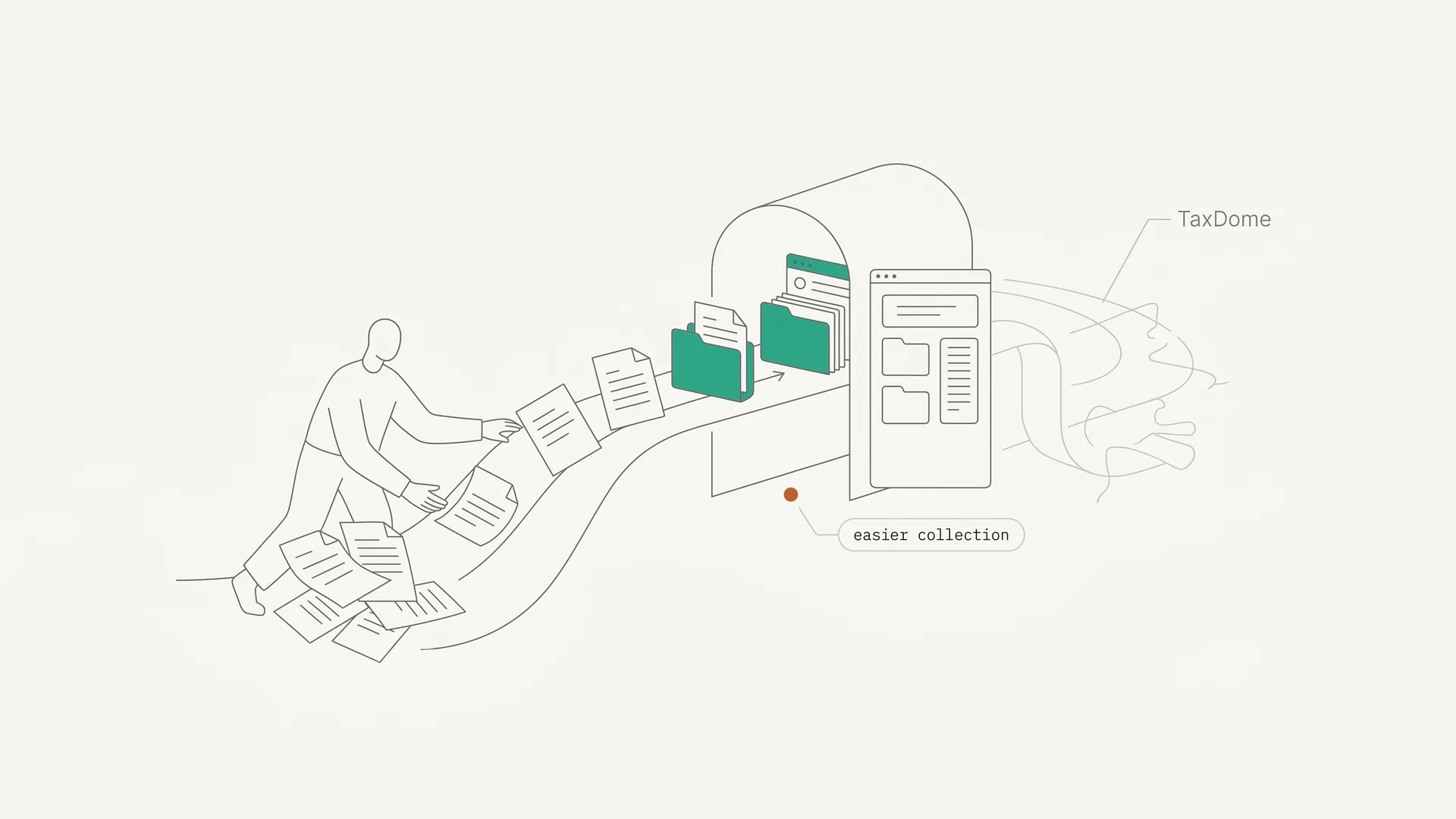
The core difference is shape. TaxDome is a practice-management suite your clients log into. DokuTrak is a document-collection layer your clients never have to log into. One replaces your stack; the other slots in front of it.
| TaxDome | DokuTrak | |
|---|---|---|
| What it is | Full practice-management suite | Focused document collection |
| Pricing model | $700–$1,000+/seat/year, 1–3 yr commitment1 | $79–$449/month, no annual lock-in |
| Client access | Login portal + mobile app2 | No account, no app: upload via a link |
| Wrong / unreadable files | Auto-renames & tags what's uploaded1 | AI flags wrong, blurry, or expired files before they reach you; you accept or reject |
| Reminders | Automated1 | Automated until the packet is complete |
| Scope | Runs your entire firm | Does one job; works alongside your GL/PM |
| Best for | Consolidating a whole practice on one platform | Collecting the documents, without the friction |
This isn't TaxDome being bad at document collection. It's a different product category. TaxDome assumes the client will come inside the platform. DokuTrak assumes they won't, and designs around that.
How can clients send documents without logging into a portal?
They click a link and upload. No account, no password, no app to install. That's the whole difference, and it's the single biggest lever on whether you actually get the documents. The friction of "create an account first" is measurable. In Baymard Institute's 2026 analysis, forced account creation is the #4 reason people abandon checkout, named by 19% of shoppers who quit for a fixable reason, inside an average documented abandonment rate of 70.22%.3 A client uploading a W-2 is no more patient than a shopper at checkout.
This is also why "just send it by email" keeps winning against better tools. A vendor comparison of Suralink put it bluntly: "some clients still default to email because logging in and uploading isn't always straightforward."4 The broader buyer shift backs it up. Gartner found that 75% of B2B buyers now prefer a rep-free, self-service experience.5 People want to complete the task on their own terms, in one tap, not learn your portal.
A no-account upload link is the slot almost no named tool owns. The login portals (TaxDome, SmartVault, Liscio) collect securely but reintroduce the account friction. The send-a-file tools remove the account but stop at collection. DokuTrak's wedge is doing both: clients upload with no account, and the files still get checked.
A no-account link is what closes the gap between "I sent the request" and "I have the files." For the broader case, see our pillar on secure client portal software and the deeper guide to a secure document upload portal.
Does a lighter alternative still catch wrong or unreadable files?
Yes, and this is where a focused tool can actually beat the suite. Removing the login gets the file in. An AI check makes sure it's the right file. TaxDome auto-tags and renames documents as they arrive, but it doesn't verify whether the client sent the correct year, a readable scan, or the document you actually asked for.1
That gap is exactly what firms complain about. Even with a suite portal, when 40 clients upload in the same week, someone still opens each PDF and figures out what it is and where it belongs — that's not the portal doing the work, that's a human doing it. Auto-renaming a wrong-year W-2 just gives you a neatly named wrong file.
DokuTrak runs an AI first pass on every upload. It flags the wrong document type, a blurry or unreadable scan, or an expired or wrong-period file before it lands on your desk, and you decide whether to accept it or bounce it back with one click. The judgment stays yours; the triage doesn't eat your week. The full mechanics are in how the AI first pass works.
Do you actually need a practice-management suite, or just document collection?
This is the question every "alternatives" list skips, and it's the one that should drive your decision. Be honest about which problem you're solving:
- You're consolidating your whole practice (CRM, billing, e-sign, workflow, communication) into one system, and you'll invest in onboarding. A suite like TaxDome, Karbon, or Canopy is the right category.
- Your real bottleneck is getting documents in. Clients ghost, send the wrong files, or won't log into the portal, and the rest of your stack is fine. A focused collection tool is the right category, and a whole suite is an expensive, heavier way to solve a narrow problem.
There's also a third, often-best answer: use both. Keep your suite or general ledger for the work, and put a no-account collection layer in front of it for the one step clients keep breaking. DokuTrak is built to sit alongside whatever you already run, not replace it, which is why it's monthly with no annual lock-in. For the vertical specifics, see DokuTrak for accountants and for bookkeepers.
What about the other TaxDome alternatives?
The usual suspects fall into two buckets, and knowing which is which saves you a bad migration. The suites compete with TaxDome head-on. The collection tools solve the narrower job DokuTrak focuses on.
The other suites (Karbon for team collaboration and larger firms, Canopy for tax-resolution with modular pricing, Financial Cents for affordable smaller firms, and Jetpack Workflow for recurring task management) are all valid if you want a full platform. They differ on price and focus, but they share TaxDome's basic assumption: the client comes into the platform.
The collection tools (Content Snare and FileInvite) are closer to DokuTrak's job, but each leaves the gap. Content Snare is a strong request-and-checklist builder. FileInvite left the self-serve small-practice market and now starts around $9,900 a year for lending teams. Neither pairs no-account upload with an AI check that flags bad files before they reach you. If you're weighing those specifically, our Content Snare alternative breakdown goes deeper, alongside the wider best client portal software roundup.
In my own teardown of nine document-collection and client-portal vendors (vendor public pages, retrieved July 2026), TaxDome was the only one whose published terms require a multi-year, paid-upfront commitment, and 5 of the 9 require the end client to create an account and log in before they can upload.
The honest summary: if you want a suite, pick the suite that fits your firm. If you want the documents to just show up (right, readable, and on time), that's the narrow job DokuTrak is built for.
The bottom line
If you need to run your entire practice on one platform, and you'll invest in onboarding your team and your clients, TaxDome is a strong, complete suite. Keep it. But if you went looking for a TaxDome alternative because the real problem is that clients won't use the portal, send the wrong files, or have to be chased every month, you don't need a different suite. You need the one job done well.
That job is no-account upload, an AI check that flags wrong, blurry, and expired files before they reach you, and reminders that run themselves, sitting alongside the software you already use.
Start a free 14-day trial of DokuTrak and send your first request in ten minutes. Solo is $79/month, Team $199, Agency $449, with a 14-day trial (first client request free with no card, then no charge today). Or see the full DokuTrak pricing first.
Footnotes
-
TaxDome, "Pricing," retrieved 2026-06-13. https://taxdome.com/pricing/ ↩ ↩2 ↩3 ↩4 ↩5 ↩6 ↩7 ↩8 ↩9
-
TaxDome, "Client portal software for accountants," retrieved 2026-06-13. https://taxdome.com/features/client-portal/ ↩ ↩2 ↩3 ↩4
-
Baymard Institute, "50 Cart Abandonment Rate Statistics 2026," retrieved 2026-06-13. https://baymard.com/lists/cart-abandonment-rate ↩ ↩2
-
DataSnipper, "DataSnipper vs Suralink comparison," retrieved 2026-06-13. https://www.datasnipper.com/resources/datasnipper-vs-suralink-comparison ↩
-
Gartner, "The B2B Buying Journey," retrieved 2026-06-13. https://www.gartner.com/en/sales/insights/b2b-buying-journey ↩
Frequently asked questions
Is there a free TaxDome alternative?
There's no full-suite TaxDome equivalent that's free for ongoing use, but focused document-collection tools cost far less than a per-seat annual suite. TaxDome starts at $700 to $800 per seat per year on a multi-year commitment. A dedicated collection tool like DokuTrak starts at $79 per month with no annual lock-in and a 14-day trial.
Can clients upload to TaxDome without an account?
No. TaxDome's client experience is a branded portal and mobile app, so clients sign in with a password to view and exchange documents. If your clients resist creating accounts, a no-account upload link, where they click and upload with no login, removes that step entirely, which is the core reason firms switch to a lighter tool.
Why do firms switch away from TaxDome?
The three recurring reasons are the per-seat annual commitment, the breadth of a full suite when a firm only needed document collection, and client friction with the login portal. Client adoption is the one that hurts most: if the people you need files from won't log in, the platform's other strengths don't reach them.
What's the cheapest TaxDome alternative for just collecting documents?
If you only need document collection, not CRM, billing, and workflow, a focused tool is cheaper and simpler than any suite. Compare on monthly price and whether clients need an account. DokuTrak is $79 per month for solo use, requires no client login, and adds an AI check on every upload that the suites don't do.
Is TaxDome or Content Snare the better alternative for document collection?
They solve different problems. TaxDome is a full practice-management suite; Content Snare is a focused document-request tool. If your bottleneck is collection, a focused tool wins, and the differentiator to look for is whether it removes the client login and flags wrong or unreadable files before they reach you.
Is there software that uses AI to check whether a client uploaded the right document?
Yes. DokuTrak runs an AI first pass on every upload and flags the wrong document type, a blurry or unreadable scan, or an expired file before it reaches you, then lets you accept or bounce it with one click. TaxDome auto-renames and tags uploads but doesn't verify the file is the right one.
Keep reading
More on collecting documents without the chase.
MyCase Alternative for Document Collection (2026)
MyCase alternative for law firms: no login required, AI flags wrong files, auto-reminders, month-to-month pricing.
New Client Onboarding Checklist (Free Template)
A free new client onboarding checklist for service businesses: welcome, contract, intake form, document collection, and kickoff, plus how to collect it without the chase.
Client Information Form Template (Free)
A free client information form template: the exact fields to collect (contact, business, scope, W-9 and docs) plus how to collect it without emailing a PDF.
Done reading?
Stop chasing clients for documents.
DokuTrak sends secure upload links, fires automated reminders, and collects everything in one searchable vault. Try it on a real client.